Letters and correspondence from Henry's life as a painter, in his own words and the words of those who knew him.
Two years before Henry left the Bay Area, Paul Mills, curator of the Oakland Art Museum, personally invited him to join a landmark exhibition alongside the painters who would come to define Bay Area Figurative art.
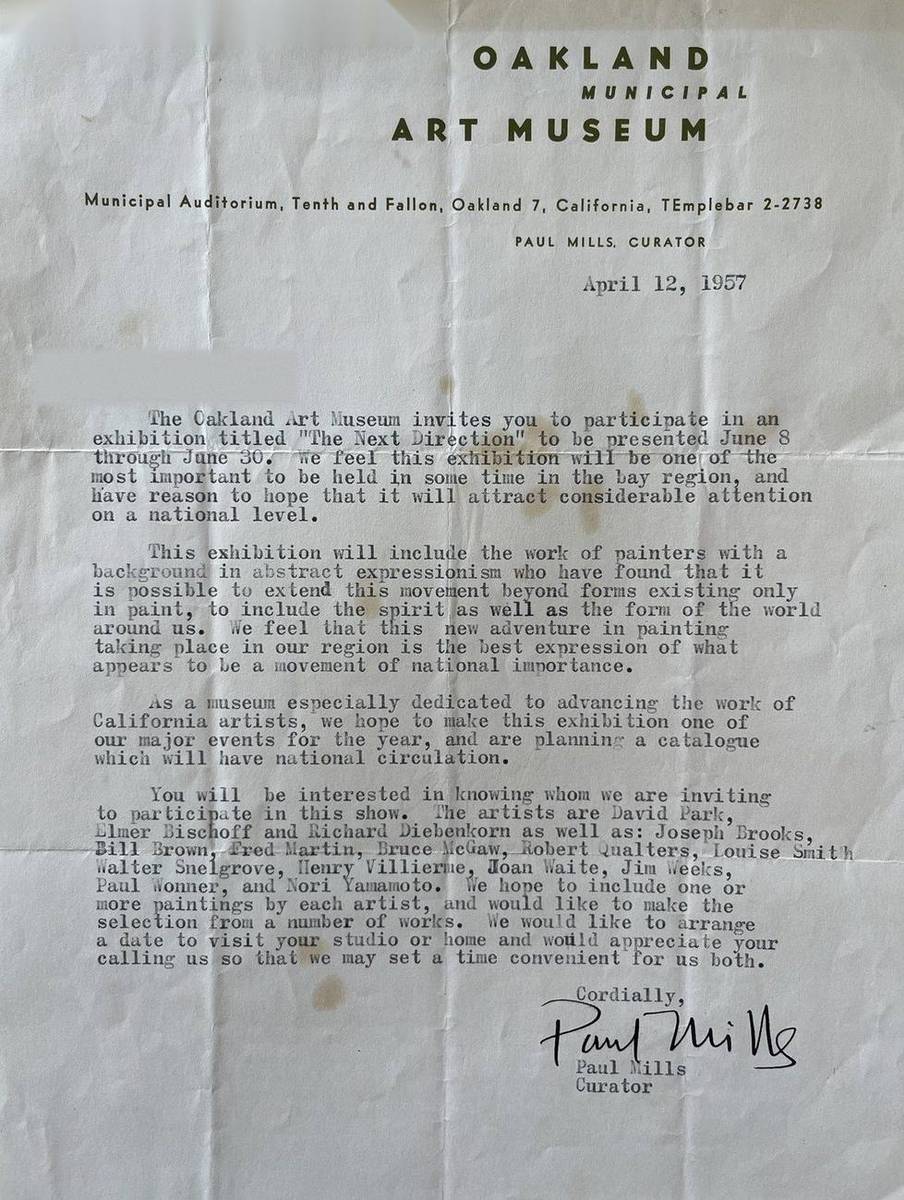
The Oakland Art Museum invites you to participate in an exhibition titled "The Next Direction" to be presented June 8 through June 30. We feel this exhibition will be one of the most important to be held in some time in the bay region, and have reason to hope that it will attract considerable attention on a national level.
This exhibition will include the work of painters with a background in abstract expressionism who have found that it is possible to extend this movement beyond forms existing only in paint, to include the spirit as well as the form of the world around us. We feel that this new adventure in painting taking place in our region is the best expression of what appears to be a movement of national importance.
As a museum especially dedicated to advancing the work of California artists, we hope to make this exhibition one of our major events for the year, and are planning a catalogue which will have national circulation.
You will be interested in knowing whom we are inviting to participate in this show. The artists are David Park, Elmer Bischoff and Richard Diebenkorn as well as: Joseph Brooks, Bill Brown, Fred Martin, Bruce McGaw, Robert Qualters, Louise Smith, Walter Snelgrove, Henry Villierme, Joan Waite, Jim Weeks, Paul Wonner, and Nori Yamamoto. We hope to include one or more paintings by each artist, and would like to make the selection from a number of works. We would like to arrange a date to visit your studio or home and would appreciate your calling us so that we may set a time convenient for us both.
Cordially,
Henry was 29 years old, the same year he would graduate CCAC, when Mills sent this invitation, placing him, by name, alongside Elmer Bischoff, Richard Diebenkorn, and David Park as the exhibition took shape. "The Next Direction" opened at the Oakland Art Museum that June.
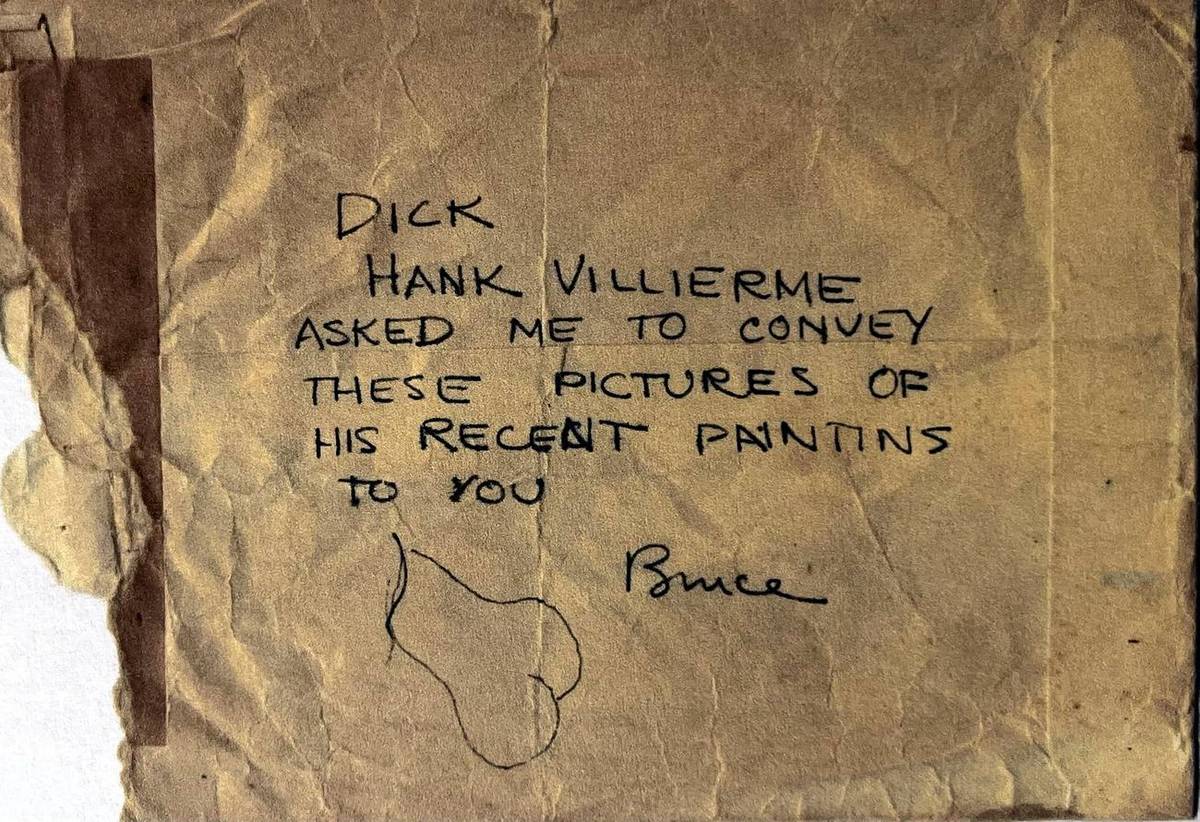
Discovered among Henry's photographs in the early 2000s: a small paper trail from Henry's first year painting in Southern California. Soon after he and Barbara settled into an apartment in Los Angeles, Henry photographed his latest work, had the film developed at a local drugstore a few blocks from home. He mailed the prints north to his CCAC classmate Bruce McGaw, who in turn passed them along to Richard Diebenkorn, so Dick could see what Henry was working on.
Dick,
Hank Villierme asked me to convey these pictures of his recent paintings to you.
Bruce sketched a small pear to the left of his signature, the same unhurried, note-passed-along-between-friends tone that runs through his longer letter below. The prints traveled with a paper trail of their own: an Owl Drug Stores receipt for two rolls of film, dropped off in August 1958 under the Villierme name, lists the address on North Cedar where Henry and Barbara were living. Five of the photographs Bruce sent on to Dick survive: one shows the paintings themselves, gathered in the garage beside the family car; the other three are sheets of individual paintings photographed against a draped sheet, evidently made for exactly this purpose, sending Dick a proper look at the new work (sheet one · sheet two · sheet three).
One of the paintings visible on the first sheet, lower right, is "Landscape," the same painting that won the $300 Junior Art Council Prize a few months earlier, at the 1958 Annual Exhibition, Artists of Los Angeles and Vicinity at the Los Angeles County Museum. Photographed here still in Henry's garage, it's a rare look at the physical canvas behind the catalog reproduction shown elsewhere on this site.
Also among Henry's papers is this photograph of "Seascape," painted that same year, which Henry would go on to show, decades later, at the Bolinas Museum's 2006 exhibition, Bay Area Figurative 1950s and 1960s, alongside his early Self-Portrait. It's another glimpse of the physical canvas behind the reproduction shown on the Gallery page, long before the painting made its way into a museum show.
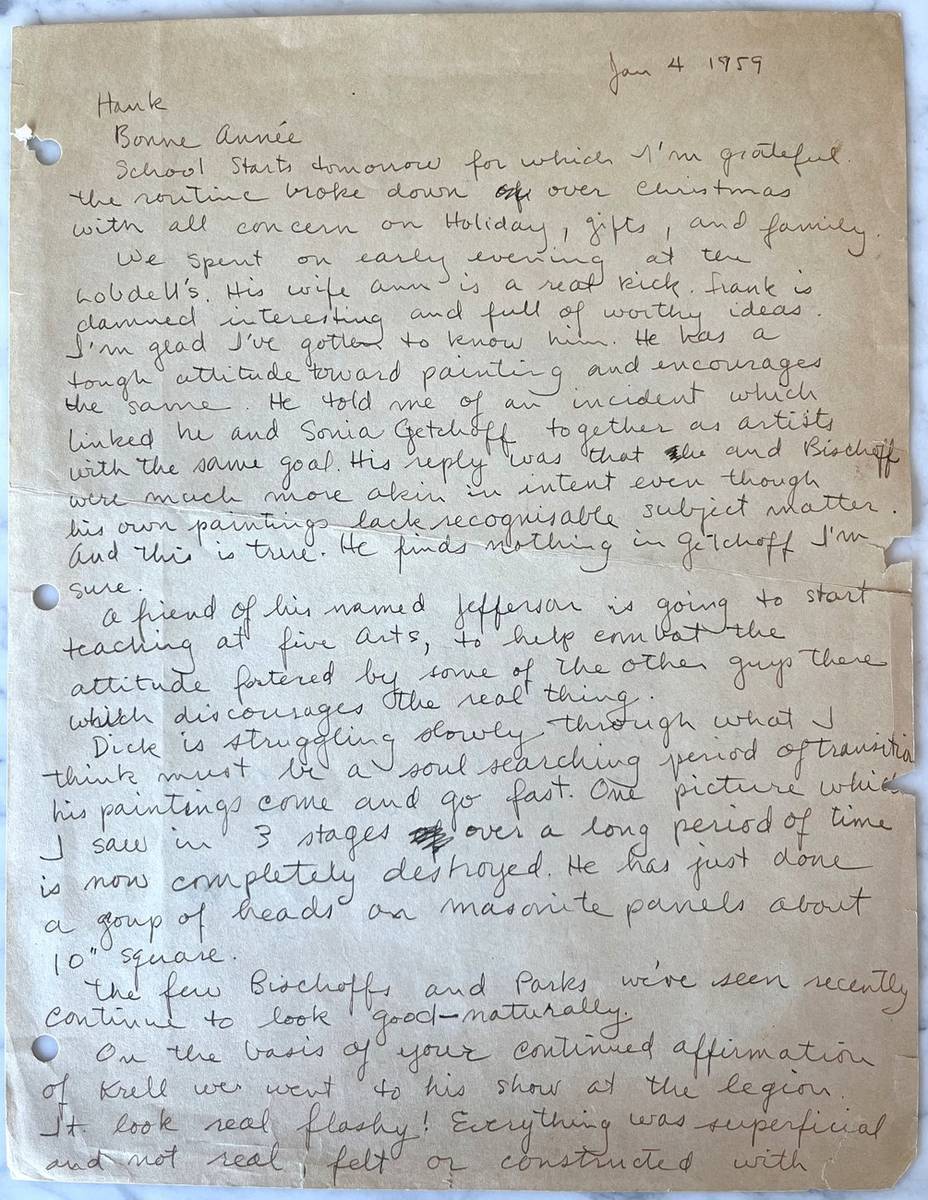
Henry's classmate from the California College of Arts and Crafts, Bruce McGaw, wrote to Henry with news from the Bay Area painting scene, addressing him by the nickname used by Barbara and a small circle of close friends:
Hank,
Bonne Année.
School starts tomorrow for which I'm grateful. The routine broke down over Christmas with all concern on holiday, gifts, and family.
We spent one early evening at the Lobdell's. His wife Ann is a real kick. Frank is damned interesting and full of worthy ideas. I'm glad I've gotten to know him. He has a tough attitude toward painting and encourages the same. He told me of an incident which linked he and Sonia Getchoff together as artists with the same goal. His reply was that he and Bischoff were much more akin in intent even though his own paintings lack recognisable subject matter. And this is true. He finds nothing in Getchoff, I'm sure.
A friend of his named Jefferson is going to start teaching at Fine Arts, to help combat the attitude fostered by some of the other guys there which discourages the real thing.
Dick is struggling slowly, through what I think must be a soul searching period of transition — his paintings come and go fast. One picture which I saw in 3 stages over a long period of time is now completely destroyed. He has just done a group of heads on masonite panels about 10" square.
The few Bischoffs and Parks we've seen recently continue to look good — naturally.
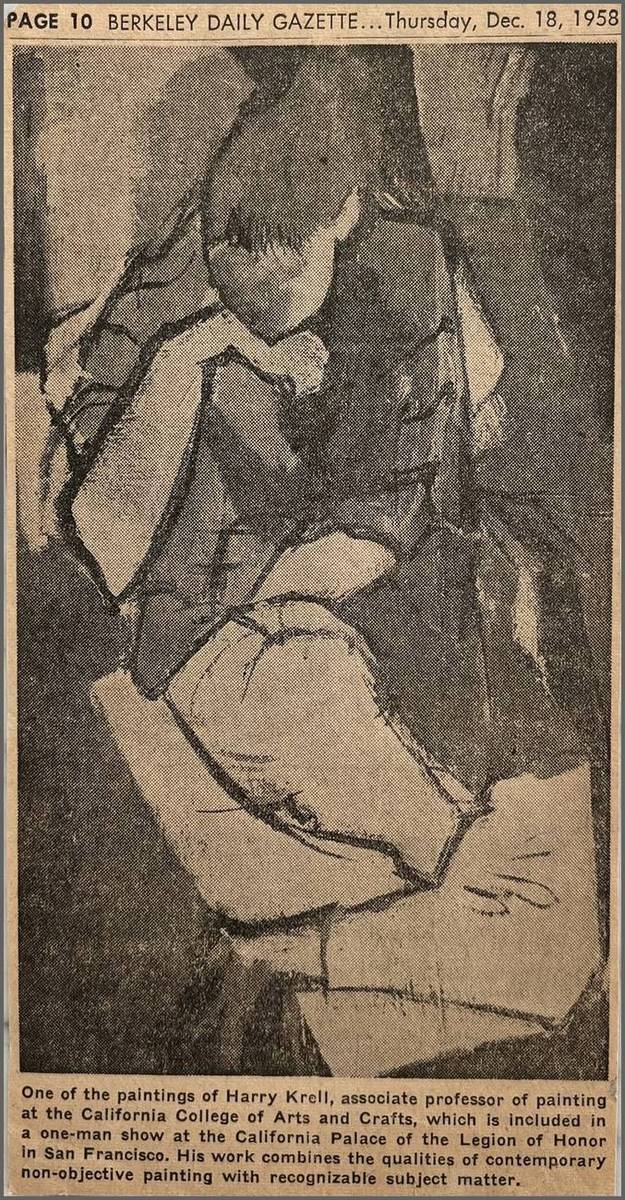
On the basis of your continued affirmation of Krell we went to his show at the Legion. It look real flashy! Everything was superficial and not real, felt or constructed with any understanding of the tradition he was trying to emulate.
I think the newspaper reproduction explains it well enough.
He's borrowed a lot from your own painting, especially the paint quality of the big landscapes you completed while living on Hamilton Place.
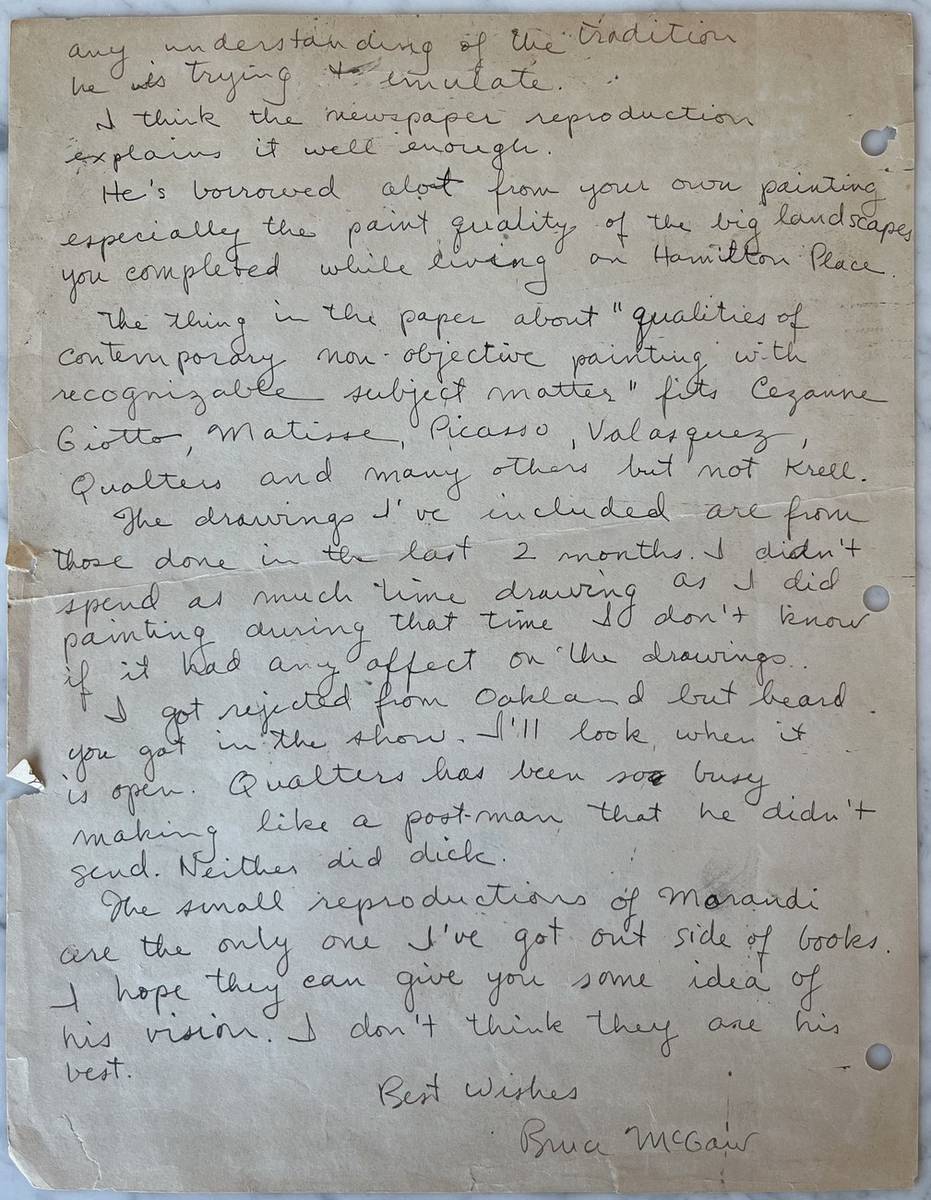
The thing in the paper about "qualities of contemporary non-objective painting with recognizable subject matter" fits Cezanne, Giotto, Matisse, Picasso, Valasquez, Qualters, and many others but not Krell.
The drawings I've included are from those done in the last 2 months. I didn't spend as much time drawing as I did painting during that time — I don't know if it had any affect on the drawings.
I got rejected from Oakland but heard, you got in the show. I'll look when it is open. Qualters has been so busy making like a postman that he didn't send. Neither did Dick.
The small reproductions of Marandi are the only ones I've got outside of books. I hope they can give you some idea of his vision. I don't think they are his best.
Best wishes,
Several figures from the Bay Area painting scene appear in this letter: Frank Lobdell and Elmer Bischoff, fellow Bay Area Figurative painters; Sonia Gechtoff, an Abstract Expressionist active in San Francisco at the time; David Park; Harry Krell; and "Dick," the nickname Richard Diebenkorn went by among his close circle of peers, including Henry. The "Marandi" McGaw refers to is very likely the Italian painter Giorgio Morandi.
The "thing in the paper" McGaw quotes almost word for word, "qualities of contemporary non-objective painting with recognizable subject matter," is this same write-up from the Berkeley Daily Gazette, published December 18, 1958, previewing Krell's one-man show at the California Palace of the Legion of Honor: the very show McGaw describes visiting on Henry's recommendation, weeks before he sat down to write this letter.
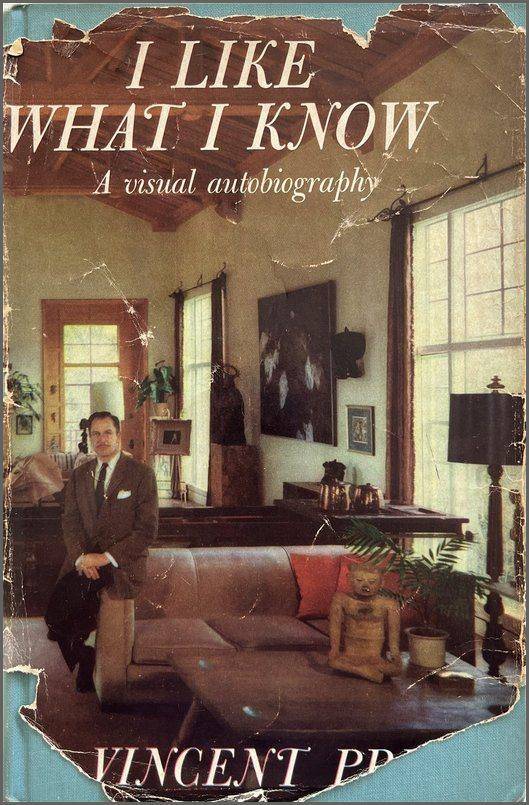
Actor and art collector Vincent Price included Henry in his book on the American art scene, a portrait of Price himself as much as the painters he named: a collector with a restless, wide-ranging eye across Europe, Latin America, and the postwar American art world.
Asking yourself questions like these is part of the fun of collecting, especially of collecting contemporary art and especially, especially contemporary American art. I don't think there's a question in anyone's mind — except perhaps the French and some Americans — that America today is the art center of the world, creatively and collectively. We are producing, and slowly the public is being weaned from the breast of Europe and buying American art. To be current with what's going on in the United States, you really have to keep your eyes open.
There are so many American painters who are better than good, and a few who are great, that I could make a list a chapter long. Gottlieb, Pollock, Rothko, Motherwell, Kline, Brook, Reginald Pollack, Okada, Reinhardt, Glasco, d'Arista, Cohen, Lebrun, Woelffer, Kienbusch, Broderson, Parks, Villierme, Strombotne, Wyeth, Perlin, de Koening, Hoffman, Kriesberg, Warshaw, Graves, Anderson, Tobey, Callahan, Diebenkorn, Morris, Amato, Brice, Sheeler, Watkins, and dozens more. There is every kind of painter, every form of vitality.
The passage is reproduced exactly as printed, including two apparent typesetting errors in the original, "de Koening" for de Kooning, and "Parks," almost certainly meant as David Park.
In a letter written on February 26, 1992, Richard Diebenkorn paid high praise to his former student.
When Henry Villierme told me in 1959 that he was leaving the Bay Area for Southern California — to take a job in a bank? — I was stunned and desperately disappointed. Of all the painting students at the California College of Arts and Crafts who might have abandoned his direction, Henry was the one whose defection could hit me the hardest.
In the studio it was always a pleasure to confront him and his painting. He was a hard and intense worker. He was anxious for words from me and I would usually come up with some nonsense, which I would interrupt by saying "Look Henry — just keep painting." But he usually had some questions and you could feel their extreme need for answers. There were never evasions, apologies, or excuses as with some students.
I enjoyed my critiques with Henry. His work was always wet and difficult to handle, would have been through hell but would not be tortured. It would be rich and very solid and just faintly bruised and slightly bloodied — ineffaceable evidence of a desperate fight. Henry would respond, "What fight?"
Beyond this, Henry's painting had, and still has, instinctual understanding of that universal human activity in which colors are applied to a surface. Henry's capacity to bring a work to a final state of open, nonintrospective resolution is impressive. There is no one whom I would feel better about describing as "a real painter."
Anyone who can bring to realization a canvas on a hilltop in a high wind, as I once observed, is to be profoundly respected.
The letter reached Henry through the gallery representing him at the time, which redacted Diebenkorn's contact information from the copy Henry received. It's a small but real loss, since it meant Henry never had the chance to write back and thank Richard directly, in his own words.
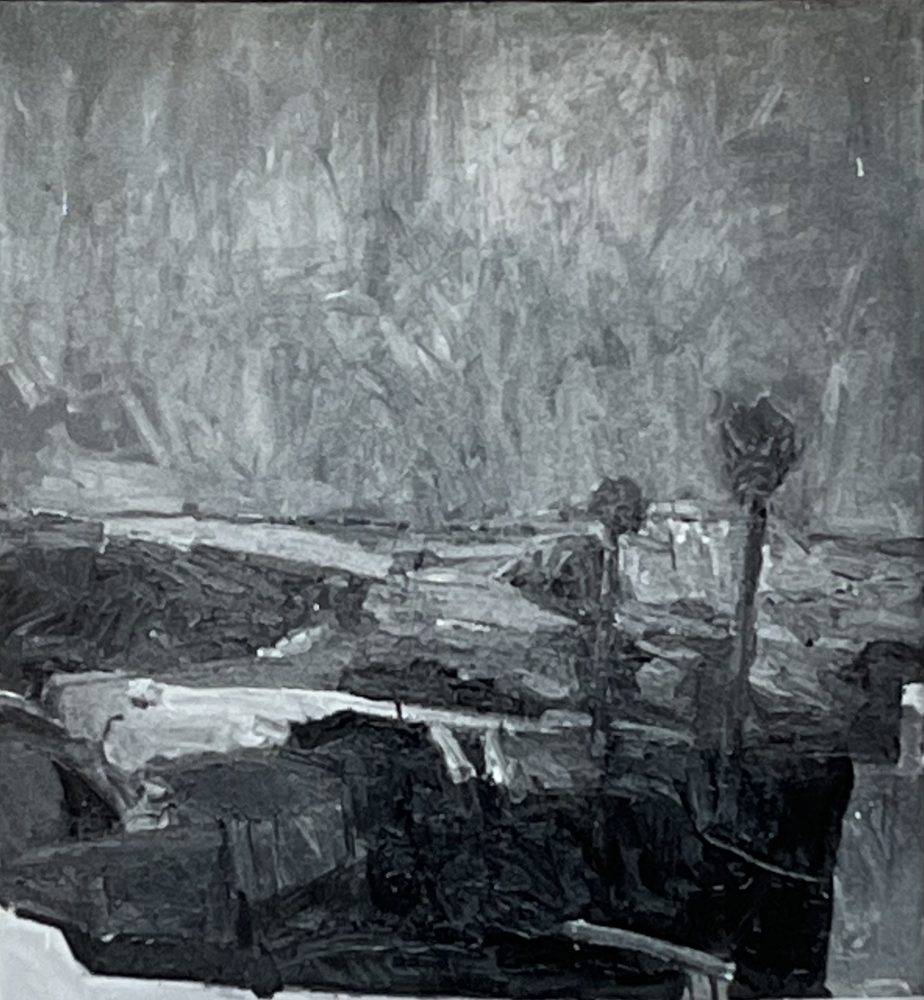
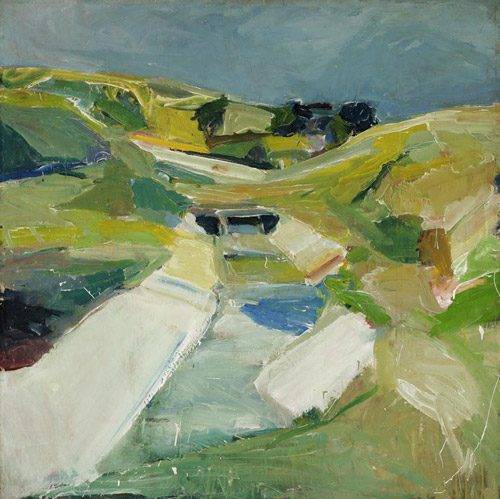
This last line refers to a painting session Diebenkorn and Henry shared in the Oakland hills, the only time the two artists ever painted together on location. Diebenkorn painted Freeway and Aqueduct (oil on canvas, 23¼ × 28 in, 1957), now in the permanent collection of the Los Angeles County Museum of Art.
Source: Richard Diebenkorn Catalogue Raisonné, RD Number 1201
Henry painted Aqueduct (oil on canvas, 56½ × 56½ in, 1957, also referred to in the past as Spillway).
In the early 1960s, not long after Henry and Barbara left the Bay Area for Southern California, Richard Diebenkorn wrote to tell Henry of an opening to teach painting at UCLA. The offer came at a formative moment. A few years earlier, the art professor and painter Harry Krell told Henry plainly that if he wanted to become the painter he was capable of becoming, he needed to give his time to painting, not to teaching. Henry took the advice to heart, declined the position, and kept painting.
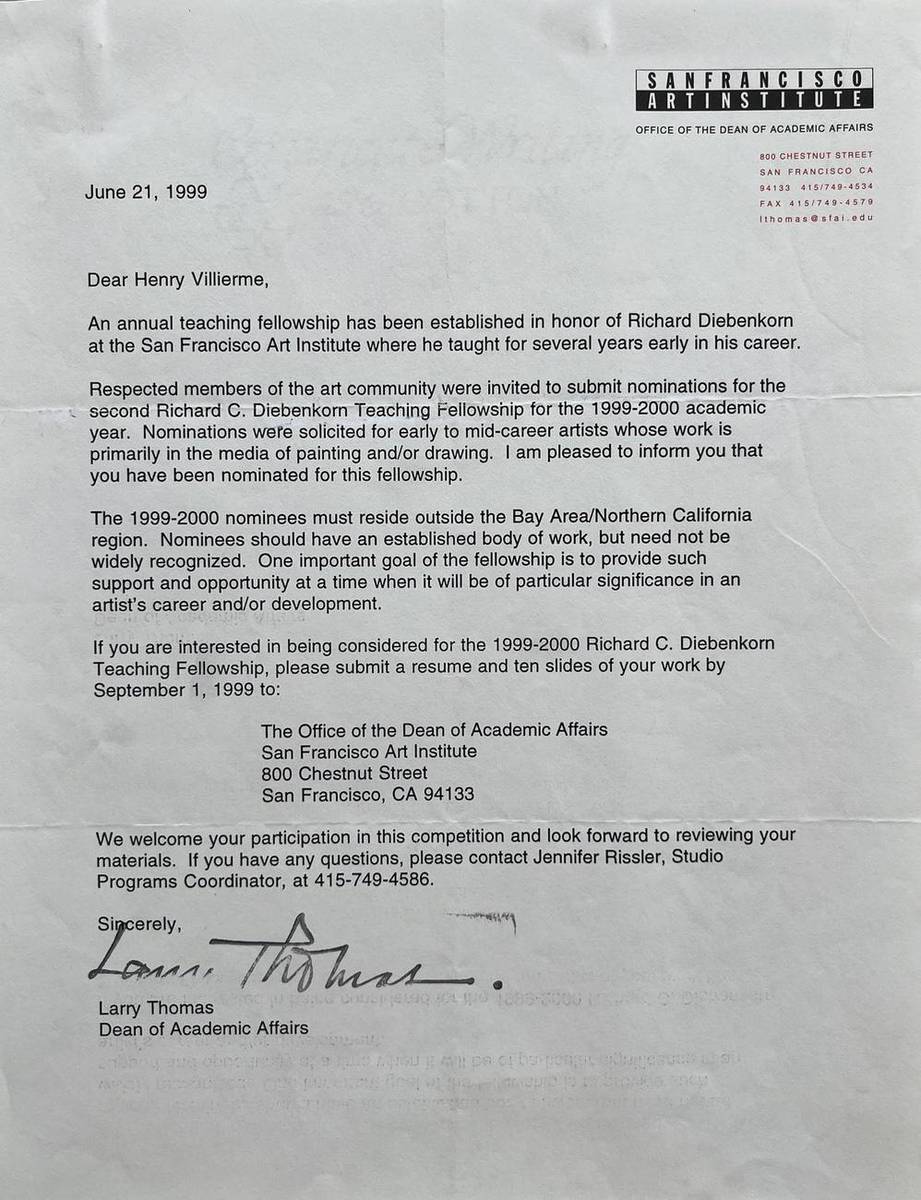
The same question returned to him nearly forty years later. In 1998 the San Francisco Art Institute established the Richard C. Diebenkorn Teaching Fellowship in memory of the painter. It was dedicated, fittingly, to giving a working artist both a teaching post and the support to keep making their own work. In 1999 Henry was nominated for it. View the call for nominations
That June, Larry Thomas, the Institute’s Dean of Academic Affairs, wrote to tell Henry he had been nominated for the fellowship’s second year, the one endowed in honor of the friend and mentor who, decades earlier, had first opened the door to teaching for him.
Henry replied by hand a few weeks later:
Thank you for the letter of June 21, 1999. I am grateful to be among the artists who have been nominated for the teaching fellowship. Although I will not be participating in this competition, know that I am honored by the Richard C. Diebenkorn Teaching Fellowship. I was fortunate to study under Richard Diebenkorn and considered him a friend and mentor.
With deep appreciation, I remain respectfully yours,
View Henry’s reply, page 1 · page 2
Henry held both men in deep regard, not only as mentors, but for the particular kind of generosity teaching asks of an artist. He had seen what Harry and Richard gave their students, and understood he couldn’t give that same measure of himself and still give himself fully to painting. Twice, forty years apart, he chose the second and let the first go.
Henry reflected on his painting session with Diebenkorn in a letter dated April 28, 2005:
How fortunate I was to attend California College of Arts and Crafts at a time when the school had much energy, good teachers including Harry Krell and Richard Diebenkorn. David Park and Elmer Bischoff taught nearby.
Diebenkorn's paintings, especially the abstract impressionistic works, drew me to take his class. This was the painter I would wish to follow. I appreciate and understand the importance spent on the learning of the basics to bring about a finished work. At some point Diebenkorn saw I was spending too much time on the basics. "Henry," he said, "open up the doors and start painting."
The day came when Richard asked me to go landscape painting. What a compliment. On this outing I was at a loss for words, but soon Richard put me at ease and I had the most memorable time. It was then I painted The Aqueduct. Happy to have had that time with Richard.
The painting Henry recalls here, Aqueduct, is pictured above alongside Diebenkorn's own account of that same afternoon in the Oakland hills.
In 2006, Paul discovered a Smithsonian Archives of American Art oral history interview with Garry Knox Bennett, a furniture maker and sculptor who arrived at the California College of Arts and Crafts the year after Henry graduated. Something in it caught his attention, and he sent his father these two condensed pages:
Dad,
I came across this article from a transcript in the Smithsonian Archives of American Art. I read the interview and condensed these two pages for you. Hope you enjoy.
Paul
The excerpt he highlighted, from an interview conducted by Glenn Adamson for the Smithsonian's Nanette L. Laitman Documentation Project for Craft and Decorative Arts in America:
Adamson: So when you got to CCAC, were you focused on painting exclusively?
Bennett: No, I went in -- yeah, yeah. Right. I thought I was a painter.
Adamson: Right.
Bennett: But I very quickly discovered sculpture, you know, three-dimensional stuff. They had some good teachers there at the time. Nothing really groundbreaking or earth-shattering, but they had really good academic teachers left over from a long time ago, Louis Miljarak and Harry Krell and a guy named -- did these hyper-realistic paintings -- Ralph Borge. And they were really strong in design.
And I remember Louis Miljarak [1901–1968] classes, where there was all these busts left over from the '20s, these plaster busts, real kind of Art Deco women and guys, you know, Mercury and shit like that. They'd put them on the floor, and it would be a fairly big class, 15 or 20 people, and you drew on newsprint with charcoal. There's nothing worse than that. The charcoal just slides across that slick surface. But you kept doing that, and then finally the day came he said, well, you could go up and get some paper, good paper, and pencil. But he made you really look at this stuff, you know? And I haven't drawn in 40 years, but I can draw really good.
Adamson: Because of that.
Bennett: And he made you save one of your drawings per week for a semester. You had to save one. And then at the end of that semester, we took turns and we put our drawings up. And, you know, about the fourth week, "Hey, man, I'm fuckin' Michelangelo," you know? You're thinking it's really good. Next week. And you put those up, and you see that progression, and you really saw you learned something.
That's one of the things I find wrong with the few institutions that I go to for slide shows or whatever, is there's no criticism. We got it, man. We got criticized. Especially Harry Krell. It was a portrait painting class, you know? And you paint. His trick was warm-cool. He had this little system, and it does work. It works very well. Light-dark. You can do a portrait with the cool on the light side, but then you've got to go warm on the back side. Or warm-cool. And that gives you a nice three-dimensional quality. And it worked really well. And every once in a while you come across an old Diebenkorn or Bischoff or something, and although they use the big, fat brush strokes, big, globby drips and all that, that's still there, man. You can see warm-cool. You know?
Adamson: Yeah.
Bennett: And even on apparently a very flat-looking portrait, it has volume to it.
Henry described that same push and pull of warm and cool colors to Paul as a key element behind his paintings. Bennett, a student at the same school, learned it from the same teacher, and could still spot it, unprompted, in a Diebenkorn or a Bischoff, years on.